Gambling ad cloaking is the most common way unlicensed casino ads get past platform review. The advertiser’s website checks who is visiting and shows two different pages: a harmless page to the platform’s reviewers, and an unlicensed casino to the people the ad is really aimed at. Here is how it works, how to recognise it, and how licensed operators and regulators can document it so platforms remove it.
Key points
- One ad, two pages: reviewers see something safe, targeted players see a casino.
- The switch depends on signals such as country, device, time of day and whether the visitor looks like a reviewer.
- Google and Meta both ban it. Google suspends accounts without warning when it detects it.
- It can be proven, but only if you test like a real target and keep a clear record.
What is gambling ad cloaking?
For example, think of a shop that hangs a “closed for renovation” sign whenever an inspector walks past, and opens its back door to customers who know the password. Cloaking does the same thing online.
When an advertiser submits an ad on Meta (Facebook and Instagram), Google or TikTok, the platform checks the ad and the page it links to, called the landing page. Advertisers build a cloaked landing page to recognise that check. The page shows reviewers and automatic scanners a compliant version. However, it sends real people in the target audience somewhere else: usually a list of unlicensed casinos, or straight to one casino’s sign-up page.
Similarly, Google describes cloaking as showing “different content to users and search engines”, and treats it as one of the most serious breaches of its rules. In other words, it is not a grey area. For example, platforms allow a translated page or a local offer. Hiding the real product is not.
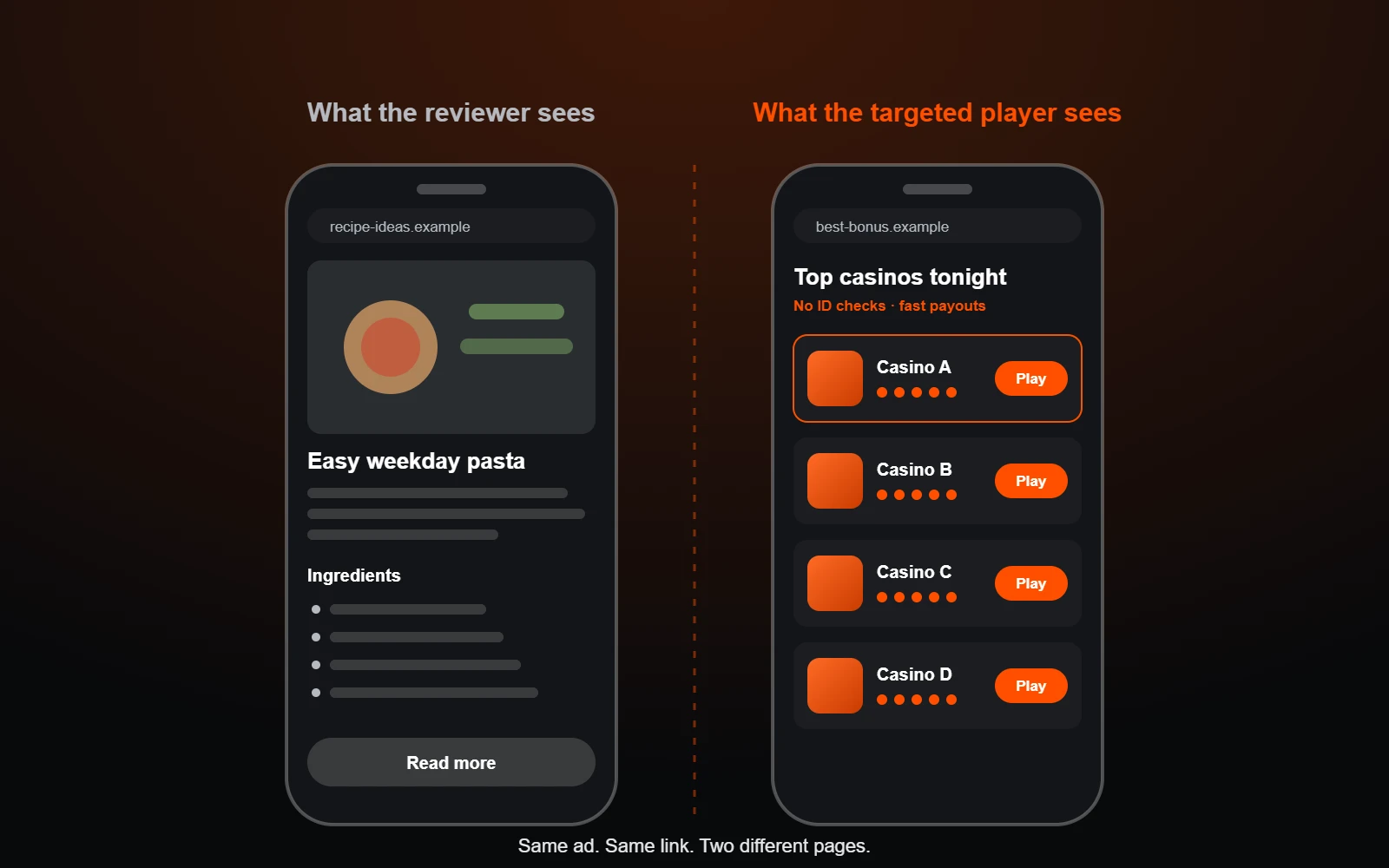
How gambling ad cloaking works, step by step
- The advertiser builds two pages. First, one is a “safe page” with nothing to do with gambling. The other is the real destination, an unlicensed casino or a page that ranks them.
- A filter sits in front of both. This is a small piece of software, often rented from a “cloaker” service, that decides which page each visitor sees in a fraction of a second.
- The ad goes to review. The platform’s reviewer or scanner opens the link and the filter shows the safe page. The platform approves the ad.
- The ad goes live. When someone who matches the target audience taps the ad, the filter sends them on to the casino, sometimes through several quick redirects (automatic jumps from one web address to another).
- Some ads change after approval. The advertiser gets a harmless ad and page approved, then swaps the image, text or destination once the ad is live, so the version real users see was never reviewed.
- The ad is short-lived by design. In practice, many of these ads run for only a day or two before the advertiser swaps in a new page, account or domain. That way they stay one step ahead of reports.

The signals a cloaker checks
First, the filter builds a quick picture of each visitor. However, no single signal decides it. The more signals that look like a “real target”, the more likely the filter sends the visitor to the casino.
| Signal | What it tells the filter |
|---|---|
| Country | Worked out from the internet address (IP address), the number that identifies a connection. Visitors outside the target market see the safe page. |
| Network type | Home and mobile connections look like real players. Office networks, data centres and VPNs (services that hide your location) look like reviewers. |
| Device and screen | A phone in the target market is a likely player. A desktop computer is often treated as a reviewer. Some funnels only work on iPhone or only on Android. |
| Browser details | Language settings, browser version and cookies (small files that remember earlier visits) help tell a person from an automatic scanner. |
| JavaScript checks | Small scripts test how the page is loaded: whether the browser runs code, how it scrolls and taps. Automatic scanners often behave differently from a person on a phone. |
| Device fingerprint | A combination of screen size, fonts, language and settings that can recognise the same device again. Devices seen before as reviewers keep getting the safe page. |
| Time of day | Some filters only switch to the casino outside working hours, when fewer reviewers are checking. |
| Where the click came from | A visitor who arrives from the ad itself is treated differently from someone who types the address in or follows it from a report. |
What the safe page usually looks like
Across our research, the safe pages fall into a few repeating types. As a result, spotting them is often the first clue that an ad is cloaked:
- Lifestyle pages: a recipe blog, a hotel or travel page, a fitness tip.
- Casual game showcases: a puzzle or arcade game with a “download” button.
- Fake error screens: a “server error” or “page not found” message, so the reviewer sees nothing to judge.
- Social casino pages: free-to-play slots with no real money, which pass review more easily.
- Pages on free website builders: quick sites hosted on the subdomain (an address like name.builder.com) of a well-known tool, which borrows that tool’s good reputation.
Advertisers also use the same trick inside the app stores. A “cloaked app” looks like a simple game or utility while the store reviews it, then switches to a casino for users in the target country. The stores usually remove these apps once they find them, but by then they can reach many people. Read more about fake app store pages used by unlicensed casinos.
Why blocking one link is not enough
Advertisers build cloaked campaigns so they can replace them quickly. Advertisers prepare many web addresses, pages and ad accounts in advance. When someone reports one address and the platform blocks it, the same ad often comes back pointing to a new one within minutes, and a third one is ready behind it.

- New addresses, same casino. In fact, the filter, the safe page and the casino at the end stay the same. Only the web address in the ad changes.
- Free and throwaway websites. Many safe pages sit on free website builders or cheap new domains, so replacing one takes seconds and costs almost nothing.
- New pages and accounts. When a platform removes an advertiser’s page or account, a new one often appears straight away. The Dutch trade association VNLOK found the number of Facebook pages carrying gambling ads in the Netherlands rose from 697 to 3,237 in a single month.
- Very short ad lives. Many cloaked ads run for less than a day, so by the time the platform reviews a report, the advertiser has already swapped the ad.
What works instead
This is why chasing single links feels endless, because the network behind them stays in place. What works is tracking the pattern: the same safe page design, the same filter behaviour and the same casino at the end of the journey. Therefore, a report that shows the whole network gives a platform what it needs to remove all of it at once, not one address at a time.
What the platforms’ rules say
- Google Ads lists cloaking under its Google Ads circumventing systems policy. It treats it as an egregious breach, the most serious level, and says the suspension “occurs upon detection and without prior warning”. Advertisers suspended for it cannot come back.
- Meta’s advertising standards on circumventing ad review say ads “must not use tactics that are intended to circumvent our ad review process”, including tactics that disguise the destination page. Every part of an ad, including the landing page, must be available for review.
- Meta has said it uses automated systems and expanded human review to compare what its own systems see with what people see, and that it bans advertisers and removes pages caught cloaking. Read Meta’s announcement on fighting cloaking.
- Google Search has a separate spam policy on cloaking and sneaky redirects for websites, which can see a site removed from search results.
The rules on gambling ad cloaking are clear. The problem is catching it. A filter that hides the casino from reviewers also hides it from automatic checks, so cloaked ads often keep running until someone outside the platform proves what real users see.
Cloaking in Google search results, not just ads
Cloaking is not only used in paid ads. Unlicensed casinos and their affiliates also use it to appear in normal Google search results, where there is no ad review at all. Three techniques come up most often:
- Canonical tags pointing somewhere else. A canonical tag is a hidden line of code that tells Google which page is the “main” version when several pages look alike. Some pages set it to point at a different website, so the page Google ranks and the page a player lands on are not the same.
- Sneaky redirects on mobile. A page shows a normal article, such as travel tips or sports news, to computers and to Google, but sends phone users straight to a casino. Google’s spam policy on sneaky redirects names exactly this: a normal page on desktop, a different spam domain on mobile.
- Borrowed and expired websites. Operators buy old websites with a good reputation, or add a section to a large trusted site, and fill it with casino content. Google calls these expired domain abuse and site reputation abuse.
In short, the test is the same as for ads: open the search result on a phone in the target country, and compare it with what a computer shows. We explain all six search tricks, step by step, in how illegal casinos get into Google search.
Why it matters now
Regulators are losing patience with gambling ad cloaking. In January 2026, Great Britain’s Gambling Commission accused Meta of “turning a blind eye” to illegal online casino ads on Facebook and Instagram. In August 2026, the Dutch trade association VNLOK reported on illegal gambling ads on Meta, finding that between 94% and 97% of gambling ads reaching Dutch users in May and June came from unlicensed operators. VNLOK named cloaking as one of the main tactics, alongside redirects to messaging apps and the misuse of licensed Dutch brands.
In other words, for licensed operators every cloaked ad is a competitor that pays no licence fee or gambling tax, ignores advertising rules, and often targets people who have chosen to self-exclude. For regulators, cloaking makes illegal advertising invisible in exactly the place they would normally look. Some unlicensed advertisers also copy real brands to look trustworthy. We cover that in how unlicensed casinos use famous brand names.
How to spot and document gambling ad cloaking
Gambling ad cloaking can be proven, but only if you test the ad the way a real target would see it, and keep a record that a platform or a court will accept. This is the method we use:
- Start from the ad library. Find the ad in Meta’s Ad Library, Google’s Ads Transparency Center or TikTok’s ad library, and save its ID and link.
- Test like a real target. Use a phone, on a home or mobile connection in the target country. An office network or a VPN will often get you the safe page.
- Record the full journey on video. Show the ad, the tap, every page and the final casino. Keep the date and time visible.
- Write down every web address. List each redirect and the final domain, the main part of the web address.
- Capture the safe page too. Open the same link from a desktop, or from outside the market, and record what appears. Showing both versions side by side is the strongest proof.
- Check the licence register. Look up the final domain in the regulator’s official list. You can find each market’s register on our list of official gambling licence registers.
- Test more than once. Since these ads change quickly, repeat the test over a few days and note any new pages or domains.
For this reason, we apply one rule in our own research: when an advertiser actively hides its final destination from the platform, we treat that as a sign it has something to hide. As a result, we class cloaked ads as unlicensed unless we can verify otherwise.
What licensed operators and regulators can do
- Report with evidence, not just a link. A report that includes the video, both versions of the page and the licence check is far harder to ignore than a single web address.
- Report patterns, not single ads. The same filter, safe page or domain often sits behind dozens of ads. Linking them together helps platforms remove whole networks.
- Protect your brand. Watch for ads and fake pages that use your name, logo or offers.
- Push for advertiser checks. Industry groups are asking platforms to verify gambling advertisers before their ads run, not after.
- Monitor all the time. One check gives you a snapshot. Cloaked campaigns change daily, so regular monitoring is what shows the real picture.
Frequently asked questions
Is gambling ad cloaking illegal?
Cloaking itself breaks platform rules rather than a single law. But using it to advertise gambling that is not licensed in a market is usually illegal under that market’s gambling law, and both Google and Meta ban it outright.
Is showing different pages to different countries always cloaking?
No. Showing a page in the local language, or a local offer, is normal and allowed. It becomes cloaking when the product or service itself changes, and the advertiser hides the real one from reviewers.
Why don’t platforms catch gambling ad cloaking?
Because cloakers design the filter to recognise their reviewers and scanners. Cloaked ads also change quickly, so by the time someone reports one, the advertiser may already be running a new version.
How can I tell if an ad uses gambling ad cloaking?
Warning signs include gambling-style ad text or images that lead to a page with nothing to do with gambling, error pages, game showcases with odd download buttons, and pages that look different on your phone than on your computer.
If we block the website, does the ad stop?
Usually not for long. The advertiser points the same ad at a new address, often within minutes. Blocking helps, but lasting results come from reporting the whole network and monitoring it over time.
Related: the 11 tactics unlicensed casinos use to get ads past platform review.
If gambling is causing you problems, free and confidential help is available. See our list of free, confidential gambling support services.
This insight is based on anonymised patterns across IGIR research. It does not name or describe any client.